|
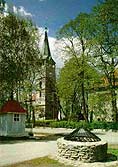
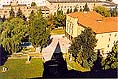
Nestling on the left bank of the Ondava rtiver and deep within the beautiful scenery of the Ondava Highlands lies the historic town of Stropkov. To the North are the famous Carpathian Mountains with their Dukla Pass. Much of the town's history involves its location and today it is close to the borders of both Russia and Poland. Early archaeologists discovered ceramics and tools here that suggest that a settlement has existed on this strategic spot since the late Stone Age. The oldest reliable records of Stropkov’s history date from 1404 and describe the town as being at the centre of a feudal estate. A large square was located near Slovak Stropkov as early as the 14th century that many believe reveals the early presence of German colonists in the town. By the 15th century Stropkov was beginning to develop as a royal property ruled by the Perinskys. The Perinskys reinforced their position in Stropkov and the surrounding district throughout the 15th century and built a large castle as a residence from which they could dominate. It is from this original castle that the local landmarks of the Gothic Church and Manor House originate.
Stropkov’s rich tradition of craft skills have their origins in the location of the old town. Being geographically isolated and prone to being caught up in border skirmishes Stropkov has seen many battles and foreign occupation by Poland, Hungary, Ottoman Turks, Germans and Russians. Consequently the town’s inhabitants would often have to flee inside the town's castle for saftey and in such times of siege they were forced into self-sufficiency with craftsmen soon becoming adept at creating all of their own basic essentials.
Under Leopold I in the 14th Century six bi-annual fairs took place in the region and records dating from 1575 show that craftsmen from Stropkov were well known not only at domestic fairs but also in the market towns of Zemplín and S^aris too. This was also the time of The Great Guild, an organisation that united goldsmiths, coopers, tailors, furriers, butchers, joiners, saddlers, belt makers, sword makers and surgeons in a kind of fair trade agreement.
By 1778 Stropkov was after Humenne, the second the biggest craft centre in Slovakia leading to the town becoming an important local political centre too. By the 1800's Stropkov's markets had become a weekly event that attracted trade from far and wide.
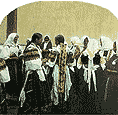
Despite a tragic history of dire poverty that brought economic stagnation and mass emigration in the 18th and 19th Centuries, Stropkov somehow survived. When the Austro-Hungarian Empire was proclaimed in 1867 Slovakia was included and after WW1 Slovakia became part of The Republic of Czechoslovakia but without doubt the country and the region's darkest hour came in 1939 when Slovakia proclaimed its independence and almost immediately became a puppet state of Nazi Germany. Under the influence of the Nazis the governing Hlinka party bought the Holocaust to the town with horrific consequences. Between 1942 and 1945 a policy of systematic eradication removed all Jewish life from the area, inhumanely destroying a large and important part of Stropkov's cultural life and craft heritage, to which Stropkov Jews had been contributing since the 17th Century.The Germans faced fierce opposition from Slovakian partisan fighters when they occupied Slovakia in 1944 but liberation only came with the aid of Russian forces in the same year.
Given such a turbulent past and the widespread destruction that came with such strife, it is truly amazing that such a small town survived at all but during Communist rule between 1968 and 1993 the government reconstructed and expanded large areas in and around the town adding the high-rise apartments that are a visible part of Stropkov today.The TESLA Company opened their main factory in Stropkov in 1960 and continue to manufacture their electrical telephonic equipment there. Since 1993 the town has been part of the new democratic Slovakia and its rich craft heritage and local natural beauty spots have begun to attract interested visitors from all over the world.
Today visitors climb to Ban^a, the highest point in the town which rises to 526 metres above sea level.From here you can see the river Ondava which gives Stropkov a rich with a wide range of water fauna and bird life and is now one of the cleanest rivers in Slovakia. Water also plays a large part in local recreation with one of the most popular leisure areas being Domas^a. Situated only 10 m from Stropkov, Domas^a is one of the biggest dams in the country and its large lake attracts many tourists and visitors from both the local population and foreign visitors from the neighbouring countries such as Hungary, Poland, the Czech Republic as well as the Netherlands and Germany. Consequently there are numerous hotels, guest houses and private holiday cottages dotted around this huge dam, together with a wide variety of restaurants, refreshment kiosks, newsagents, water sport centres and shops.
Let’s hope that the participants from the UK on this year’s TICATEC Exchange get the opportunity to sample everything that this wonderful part of Slovakia has to offer.
|
|